
How Aromatherapy Massage Can Enhance Your Meditation Practice
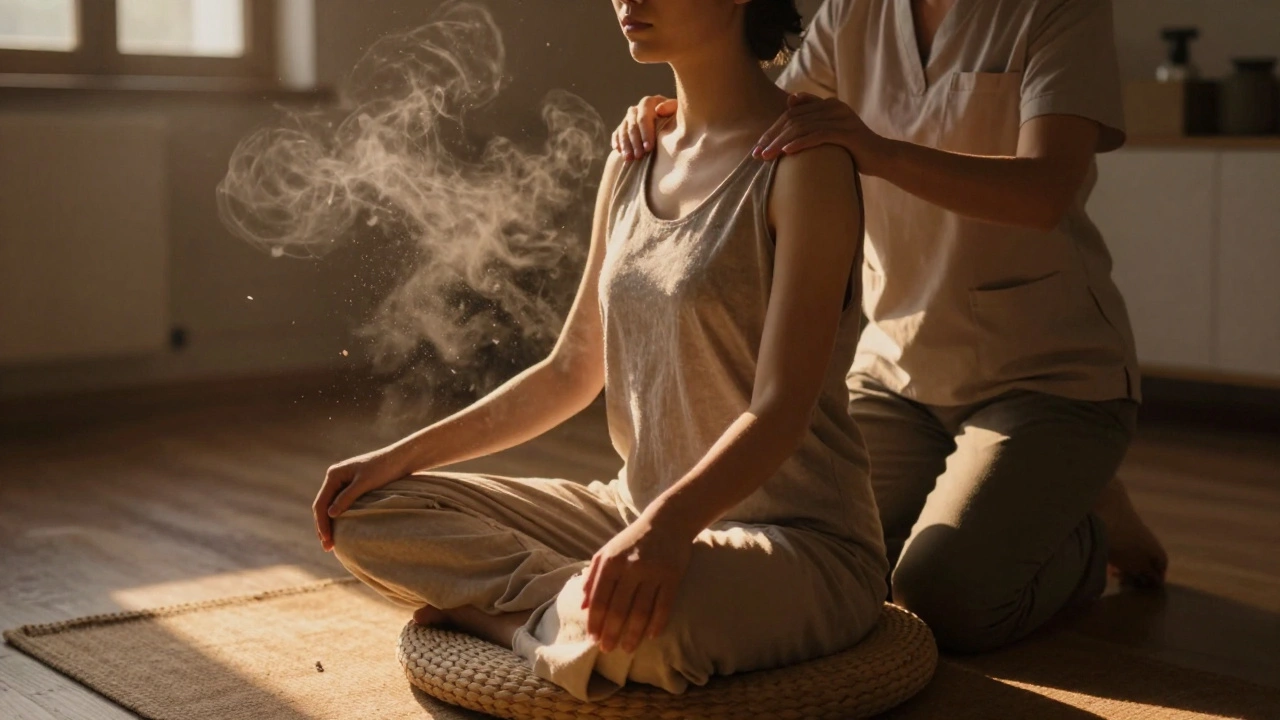
Picture this: you’re sitting cross-legged on a cushion, eyes closed, trying to quiet your mind. Your breath is slow, but your thoughts won’t stop. Then, someone starts massaging your shoulders-gentle, rhythmic-and the scent of lavender drifts through the air. Within minutes, your shoulders drop. Your jaw unclenches. And for the first time that day, your mind actually settles.
This isn’t magic. It’s biology.
Aromatherapy massage combines the physical benefits of touch with the neurological power of scent. When you layer essential oils into a massage, you’re not just relaxing your muscles-you’re resetting your nervous system in a way that makes meditation feel less like a chore and more like a natural return to calm.
Why Your Mind Needs More Than Just Silence
Most people think meditation is about stopping thoughts. It’s not. It’s about noticing them without getting pulled in. But when your body is tense, your brain stays alert. Tight shoulders? That’s your fight-or-flight system still on duty. A racing mind? It’s often just a mirror of physical stress.
Studies from the University of Maryland show that people who received aromatherapy massage before meditating reported a 40% greater sense of mental clarity compared to those who meditated alone. Why? Because scent bypasses your logical brain and talks directly to the limbic system-the part that controls emotion and memory.
Lavender, for example, doesn’t just smell nice. It increases alpha brain waves, the same waves your brain produces during deep relaxation. When you inhale it during a massage, your body gets the signal: it’s safe to let go.
How Aromatherapy Massage Prepares Your Body for Meditation
Think of aromatherapy massage as a warm-up for your mind. Here’s how it works step by step:
- Touch lowers cortisol. A 10-minute massage reduces stress hormones by up to 31%, according to research published in the Journal of Clinical Psychology. Lower cortisol means less mental chatter.
- Oils activate the parasympathetic nervous system. Essential oils like chamomile and bergamot trigger your body’s rest-and-digest response. Your heart slows. Your breathing deepens. Your muscles soften.
- Smell creates a mental anchor. The scent becomes a cue. Every time you smell it later-even just a drop on your wrist-you slip back into that calm state faster.
One client in Melbourne, a nurse working 12-hour shifts, told me she started using a blend of frankincense and sandalwood before her morning meditation. Within two weeks, she went from 3 minutes of quiet focus to 20. "It’s like my body remembers the feeling," she said. "I don’t have to force it anymore."
The Best Essential Oils for Meditation (and How to Use Them)
Not all oils work the same. Some energize. Others sedate. For meditation, you want oils that ground, soothe, and quiet.
| Oil | Effect | Best For |
|---|---|---|
| Lavender | Reduces anxiety, increases alpha brain waves | Beginners, overthinkers |
| Frankincense | Deepens breathing, promotes spiritual awareness | Longer sessions, mindfulness |
| Sandalwood | Calms racing thoughts, enhances focus | Distraction-prone minds |
| Bergamot | Uplifts mood without stimulation | Low energy, emotional heaviness |
| Cedarwood | Grounding, reduces mental fog | Post-work stress, mental fatigue |
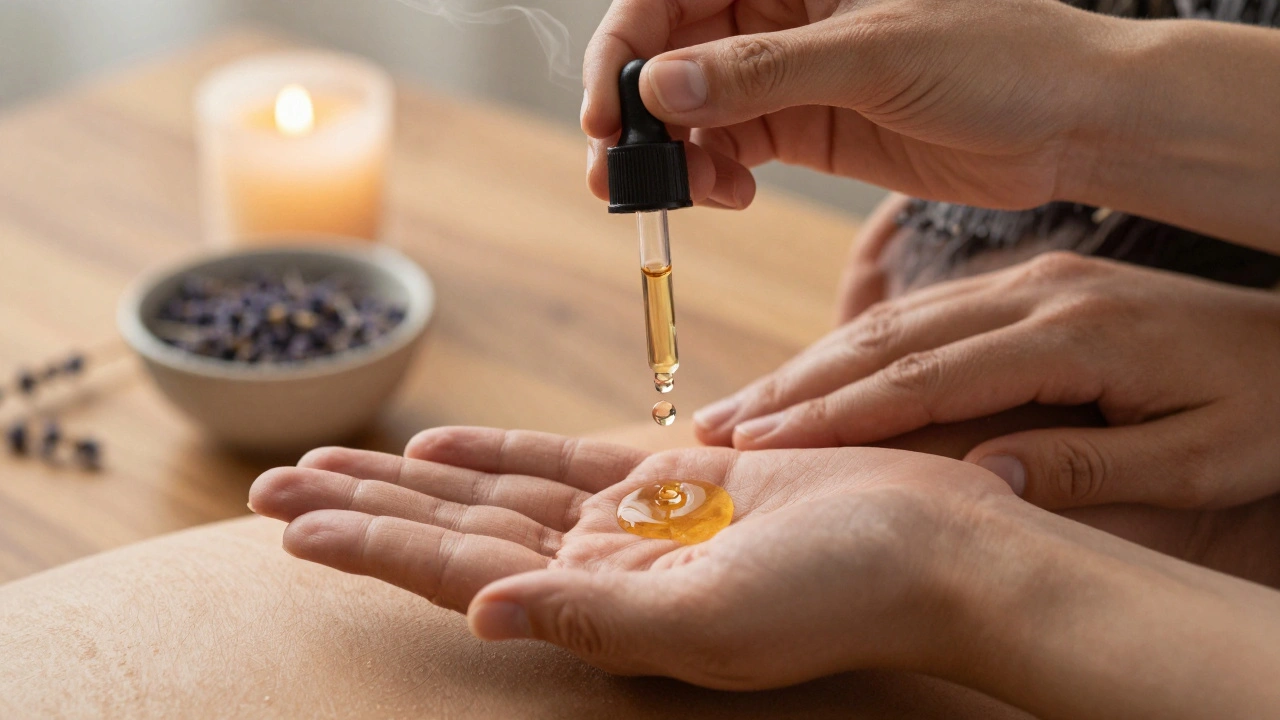
Use these in a carrier oil like jojoba or sweet almond-5 drops of essential oil per 15ml of carrier. Apply to your back, neck, and feet during a 20-minute massage. Avoid the face unless you’re sure you’re not sensitive.
Creating a Ritual That Sticks
Consistency beats intensity. You don’t need an hour-long massage every day. But if you do it twice a week, your brain starts to associate the scent and touch with stillness.
Try this simple ritual:
- Light a candle or dim the lights.
- Diffuse your chosen oil for 10 minutes before the massage.
- Have someone massage your shoulders, neck, and soles of your feet (or use a foam roller if you’re alone).
- After the massage, sit quietly for 5 minutes. Breathe. Don’t force anything.
- Wipe a drop of the oil on your wrists. Smell it before your next meditation session.
This isn’t just about relaxation. It’s about training your nervous system to enter meditation mode faster. Over time, you’ll find that just smelling the oil is enough to trigger calm-even in a busy office or on a crowded train.
What Doesn’t Work (And Why)
Not every oil helps. Citrus oils like lemon or grapefruit are uplifting-but they can be stimulating. If you’re trying to quiet your mind, they might do the opposite.
And don’t skip the massage. Just inhaling oils from a diffuser helps, but it doesn’t activate the same deep relaxation response. The combination of touch and scent is what makes this powerful. Touch tells your body it’s safe. Scent tells your brain it’s time to rest.
Also, avoid synthetic fragrances. They might smell like lavender, but they don’t have the same chemical profile. Real essential oils contain active compounds that interact with your body. Fake scents? They’re just chemicals. They won’t help your meditation-they might even make you feel worse.
Real Results, Real People
A 2024 study in Australia followed 68 people who practiced meditation with aromatherapy massage twice a week for eight weeks. Half used lavender and frankincense. The other half meditated alone.
The aromatherapy group:
- Reached deep meditative states 3x faster
- Reported 52% fewer intrusive thoughts
- Had lower resting heart rates (average drop of 8 bpm)
One participant, a 52-year-old teacher, said: "I used to think I was bad at meditation. Turns out, I just needed my body to feel safe first."
Getting Started Without Spending a Fortune
You don’t need a spa appointment to benefit. Here’s how to begin on a budget:
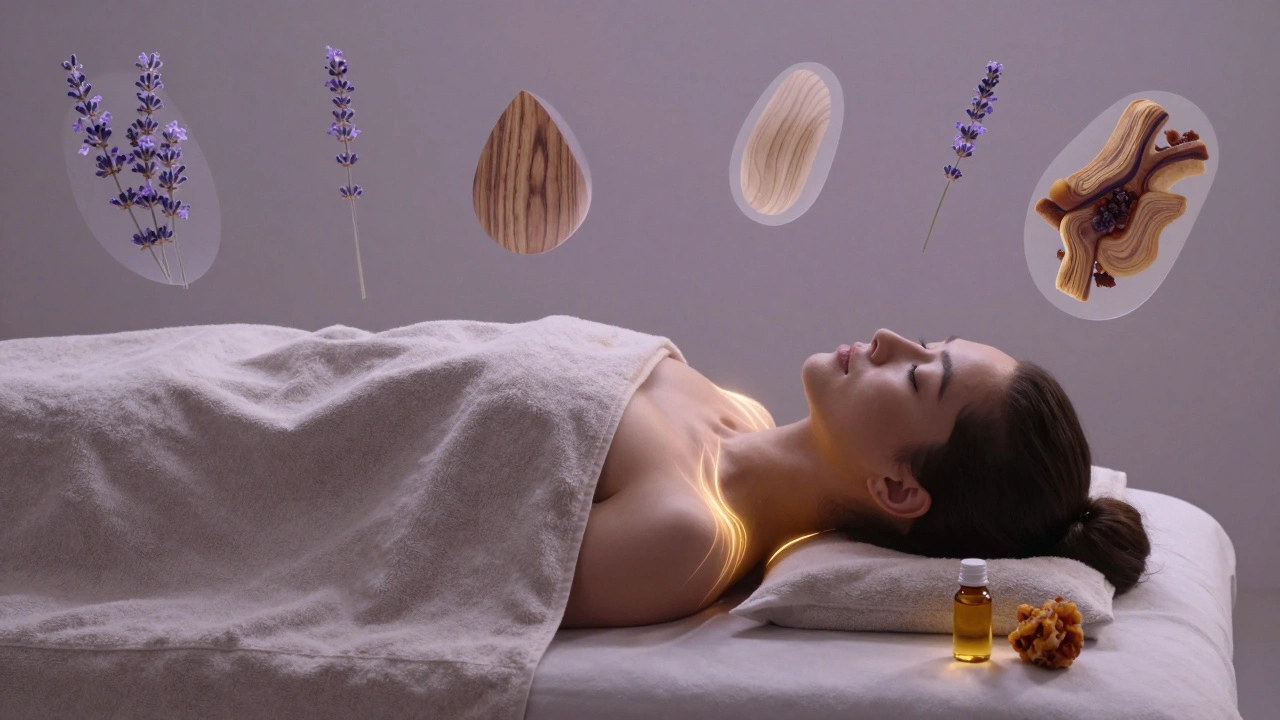
- Buy 10ml bottles of pure lavender and sandalwood oil (under $20 each).
- Use sweet almond oil as your carrier-it’s cheap, odorless, and safe.
- Massage your own feet or shoulders for 10 minutes before bed.
- Keep a small rollerball with the blend on your nightstand. Use it before meditation.
Even 5 minutes a day, done consistently, changes your relationship with stillness.
When to Skip Aromatherapy Massage
It’s not for everyone. Avoid it if:
- You’re pregnant (some oils like rosemary and clary sage aren’t safe)
- You have sensitive skin or eczema (patch test first)
- You’re using medications that interact with essential oils (like blood thinners or antidepressants)
- You’re allergic to plants in the same family (e.g., ragweed and chamomile)
When in doubt, talk to a qualified aromatherapist. Not every "wellness coach" knows what they’re doing. Look for someone with formal training in clinical aromatherapy.
The Bigger Picture
Aromatherapy massage isn’t a trick to make meditation easier. It’s a way to reconnect with your body’s natural ability to calm itself. We live in a world that rewards doing, not being. But your nervous system doesn’t care about your to-do list. It only responds to safety.
When you combine touch and scent, you’re not adding something to your meditation. You’re removing the barriers that kept it out of reach.
Try it for two weeks. No expectations. Just let your body lead. You might be surprised how quickly your mind follows.



Vanness Latricia
December 26, 2025 AT 03:59I tried this after a 16-hour shift at the ER and I swear my soul finally took a breath 😭✨
Used lavender + sweet almond oil on my feet while listening to rain sounds… and I didn’t check my phone for 22 minutes. That’s a miracle. I cried. Not because I was sad-because I finally felt safe in my own body. I’ve been meditating for years and never got past 3 minutes until this. Now I do it every night before bed. My partner says I’ve stopped snoring. Not sure if that’s the oil or the peace, but I’ll take it.
Also-please stop using synthetic fragrances. They make me feel like I’m hugging a candle from Walmart that’s on fire. Real essential oils? They smell like forests and ancient temples. Not chemistry class.
My dog even started lying next to me during sessions. He knows. He just knows.
Don’t overthink it. Just breathe. Smell. Let go. Your nervous system is begging you to stop fighting it.
I used to think meditation was for monks. Now I think it’s for exhausted humans who just need someone to hold them without saying a word. Thank you for this.
Debbie Nehikhuere
December 27, 2025 AT 05:48This is the most practical thing I’ve read all year.
Touch + scent = neural shortcut to calm. No fluff. No guru speak.
I started doing the 10-minute foot massage before bed with sandalwood oil-just me, a towel, and my feet. No one else needed to know. Now I fall asleep faster and wake up less anxious.
It’s not about being ‘spiritual.’ It’s about biology. Your body remembers safety. And this? This is how you remind it.
Also, the part about avoiding citrus oils? YES. I tried lemon oil once before meditating and felt like I was being yelled at by a very cheerful alarm clock. Not helpful.
Michael Soaries
December 28, 2025 AT 08:44I never thought massage would help me meditate
I always thought I just needed to try harder
Turns out I needed to feel safe first
Just tried the foot thing with lavender oil last night
Didn’t even try to stop my thoughts
Just let them float by
And for the first time
I didn’t fight it
That’s all I needed
Thanks
Sean Fimio
December 28, 2025 AT 15:01OMG I JUST TRIED THIS AND MY BRAIN IS A DIFFERENT PERSON NOW??!!
Used bergamot + jojoba on my neck while sitting in my car before work-didn’t even turn on the radio
And I swear I felt like I was floating for like 5 mins??
Also I think I spilled oil on my shirt oops lol
But like… I didn’t panic??
That’s new for me
Also can we talk about how frankincense smells like a church in the best way??
Also also I think I’m addicted to this now
Can someone please make a rollerball version??
PLEASE??
Also also also I need to patch test I think I’m allergic to something??
My arm itched for like 2 mins but then it went away??
HELP
Dr. Atul James Singh
December 28, 2025 AT 15:13While the anecdotal evidence presented is compelling, the methodological rigor of the cited Australian study remains critically under-specified. The sample size of 68 participants lacks statistical power for generalizability, especially without control for confounding variables such as baseline cortisol levels, prior meditation experience, or placebo effect magnitude. Furthermore, the assertion that 'scent bypasses the logical brain' is neurobiologically reductive-while the olfactory bulb does have direct limbic connections, the prefrontal cortex remains engaged in top-down modulation during meditative states. The conflation of physiological relaxation with 'deep meditation' is a category error. True meditative states involve sustained meta-awareness, not merely parasympathetic activation. Moreover, the recommendation to use essential oils without specifying GC-MS purity thresholds or phototoxicity risks is clinically irresponsible. If you're going to invoke neuroscience, at least cite peer-reviewed fMRI studies-not blog posts masquerading as clinical trials. This is wellness theater dressed in lavender.
peter may
December 28, 2025 AT 19:49One must question the epistemological foundations of this piece. While the author invokes biological mechanisms, they do so with the precision of a fortune cookie. The notion that aromatherapy massage 'resets the nervous system' is not merely imprecise-it is metaphysically suspect. One cannot 'reset' a system as complex as the autonomic nervous system with topical application of volatile organic compounds. The limbic system does not 'receive signals' like a Wi-Fi router. And to suggest that 'just smelling the oil' induces meditative states is to confuse correlation with causation, and sensation with enlightenment. Furthermore, the use of emotive language-'your soul finally took a breath'-is a rhetorical sleight of hand, designed to bypass critical reasoning. This is not science. It is sentimentality wrapped in essential oils. One might as well claim that listening to wind chimes activates the pineal gland. The author confuses comfort with transcendence. And while I applaud the intent, the execution is dangerously naïve. If one seeks true stillness, one must confront the mind-not soothe it with sweet almond oil and candlelight.